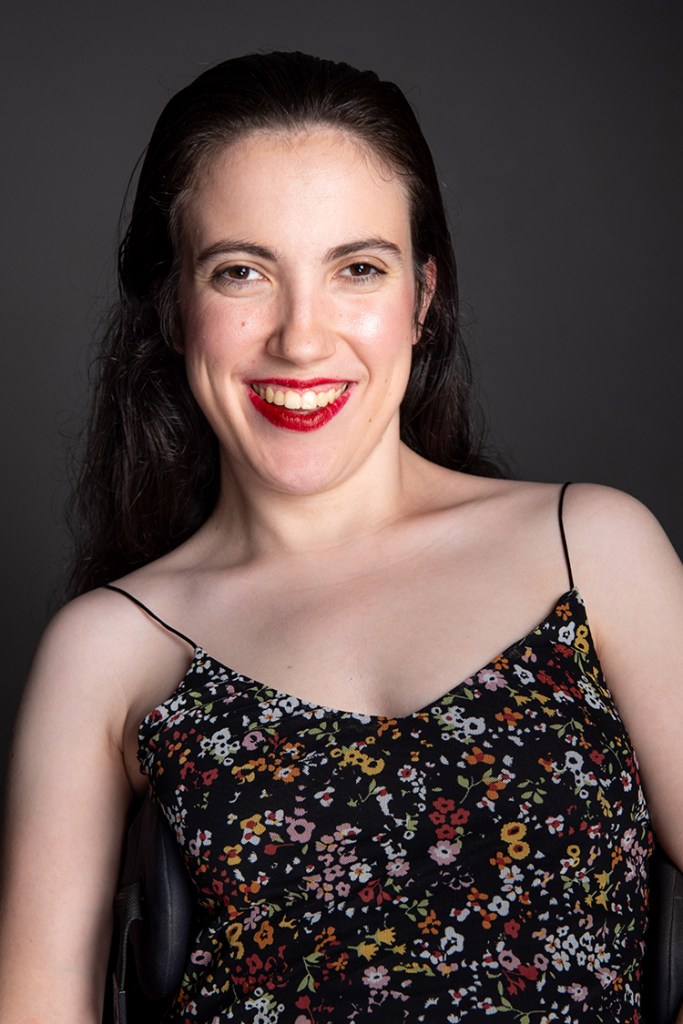
In February, our ANDPA book club is reading I’ll Let Myself In by Hannah Diviney – a defiant coming-of-age story about a young woman learning to embrace all that she is: the good, the bad, and the messy in-between.
We chat with Hannah about writing, vulnerability, representation, storytelling, and inclusion.
Your book blends personal reflection with social commentary. How did you find the balance between vulnerability and advocacy in your writing?
Hannah Diviney: For me, I’ve always been one of those people who leads with their heart, so I don’t really know how to hide things from people when I’m telling a story. I’ve never been good at playing games or pretending to be someone I’m not which is kind of ironic considering I’m literally an actor. For me, vulnerability and advocacy are intricately intertwined. I know we hear this all the time but it really is true that the personal is the political and that there’s really no separation of those two things for marginalized communities. So, I think by virtue of being an advocate you just naturally become vulnerable and put yourself in a place where being honest is as much a part of your craft as the way that you tell a story. Plus, as much as I wanted this book to have an audience, I was also very much writing it for myself and the only way to really own my story and all the things that have been part of my life, was to be honest.
Can you describe a moment during the writing process that was especially challenging, or unexpectedly enlightening?
Hannah: This feels like such a cop out answer, but honestly the whole thing?
It was like going to therapy every day for hours on end and forced me to be really honest with myself and reflective about things that that had happened and patterns that I’ve fallen into or bad behaviours or ways of thinking or looking at the world or ways of perceiving myself that I had internalised. I think when you write something about yourself it can feel like an exercise in grandeur and self-importance but that wasn’t why I wrote it. In hindsight, it turns out the goal I kind of had was writing the book in such a way that I used it to help me understand myself, even if I didn’t necessarily entirely know that at the time. And then luckily, it turned out that people resonated with what I wrote and thought it was good enough to be published.
I think some of the most enlightening work that I did though, was probably the mental health chapters and the things that I hadn’t really written or said out loud before but had kept private and then seeing them on the page meant that I had to address them and move forward. I actually think the whole experience sort of propelled me forward in ways I didn’t expect and god I have already grown so much since that book came out. There’s so much of it that would be different or added too now so I don’t know… maybe I’ll write another essay collection eventually.
Looking back on your younger self, what’s one thing you wish you could tell her, and how does that inform how you write for others now?
Hannah: Oh man so many things! For starters, I’d probably want to tell her that life is going to be full of unexpected twists and turns like all her favorite fantasy novels and that every time she thinks she knows what’s coming next or that things might have slowed down for a minute or that they were just a flash in the pan, spoiler alert: they weren’t. I’d also tell her that sometimes I’m still afraid of the things that she’s afraid of but that the great thing about getting older is that we have now figured out a way to be afraid but do things anyway. I’d also tell her to dream bigger because I think in one way or another most of the dreams I had as a kid have found a way to exist in my real life now and that’s a pretty special spectacular thing.
In terms of how it informs my writing for others now, I mean I’m always operating from the place of what would have helped me? What did I need to see that I never got to? That might have made life easier? Or that might have made all of these questions and insecurities and things in my head less fraught to navigate?
Obviously I can’t take away the struggle or the specific experience of having to come to terms with being a person with a disability as a kid or as a young adult, but hopefully I can make it less lonely in the sense that there’s very clear paths and people that the next generation can lean on if they want to sort of help them find their own way. But in saying that I never want people to feel like there’s any sort of pressure to follow me or that my way of living or doing things or the career that I have and will hopefully continue to have is the only way. I never want people to feel like they have to be the ‘next me’ because that’s not interesting. I want them to be themselves
Representation is a theme in your book. What do you hope readers take away about why it matters?
Hannah: Representation is possibility. It’s opportunity. Permission to dream. It makes it so much easier to draw up the blueprints for your own life whatever that might look like because you have a frame of reference or a map however much you choose to lean on it. I hope that people understand that representation matters because the cost of not having it is thinking you don’t deserve to exist and that’s exhausting.
What role do you think storytelling (your own and others’) plays in shifting public perceptions about disability and inclusion?
Hannah: To me, storytelling is the closest thing to real life magic that we have. It’s existed for millennia and I think everything that we understand about each other and about the world is built on stories. The ones we’re told, the ones we tell, the ones that are left out the ones that are elevated over others or even who gets to tell them – all of that stuff. Storytelling is also a really powerful force against fear, misinformation, bigotry, hate anger and all of those emotions that drive things to be more divided or dangerous for people who exist in marginalized bodies and spaces. I see my role as a storyteller as a huge responsibility and because of this kind of treat everything that I do as part of the story I’m telling whether it’s people seeing me out in public or a piece of writing that I share or a part that I take on. It’s all kind of connected in this woven tapestry and I think hopefully what I’m doing with my work and what I’m doing with my life, in the way that I’ve chosen to live it and in the way that I’ve chosen to give people access to at least parts of it is advocating just by example. I like forming resistance to stories that are flawed or that no longer fit the mold by creating new ones.
What upcoming projects or themes are you excited to explore next? Either in writing or in your broader work.
Hannah: Ooh, that’s a good question? I think I’m very curious about love. I’m writing a screenplay. I again really want to get into the nitty gritty of the stories we tell ourselves and the stories we hold in our minds about other people in all sorts of ways. Sorry, I know that’s secretive and mysterious but I promise it will eventually all make sense.
 ANDPA
ANDPA 